


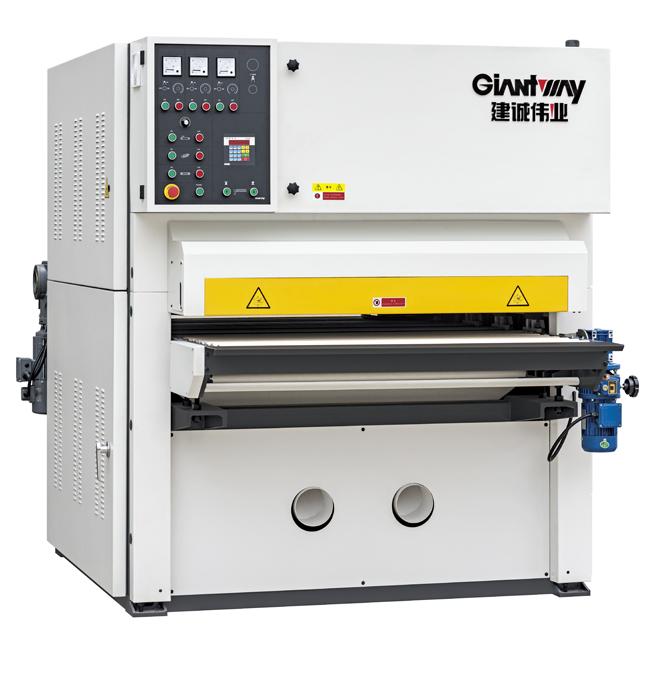
This machine is primarily designed for sanding the bottom surface of boards to a desired thickness. It is suitable for a variety of furniture, wooden doors, cabinets, veneer boards, and painted surfaces. It can be used in conjunction with any surface sander to form a sanding line. This connection is primarily for customers with larger production volumes.
After the surface of the board is sanded to a desired thickness by the surface sander, it passes through a conveyor table and is then transferred to the DSG1350R-R-RPA sanding roller for sanding the bottom surface to a desired thickness. This connection allows the sanding requirements of both sides to be completed at once, reducing labor costs and improving production efficiency. It is currently the most effective way to improve efficiency by upgrading sanding equipment.
Featured Configuration
1. Suitable for fine sanding of the bottom surfaces of various furniture, wooden doors, cabinets, and boards. It can be used in combination with any surface sanding equipment and is the best choice for upgrading sanding equipment to improve efficiency.
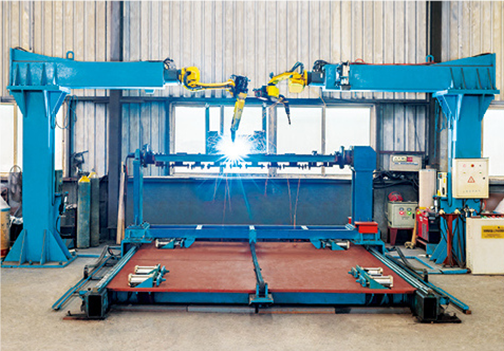
2. The equipment frame is welded from thick-walled rectangular steel pipes and has undergone aging treatment. It is strong, stable and not easy to deform, which reduces the vibration of the body when sanding the plate and ensures the sanding accuracy.
3. The crossbeam is made of high-quality manganese steel, which is not easy to break and has high bending strength, which improves the stability of the sanding roller during operation.
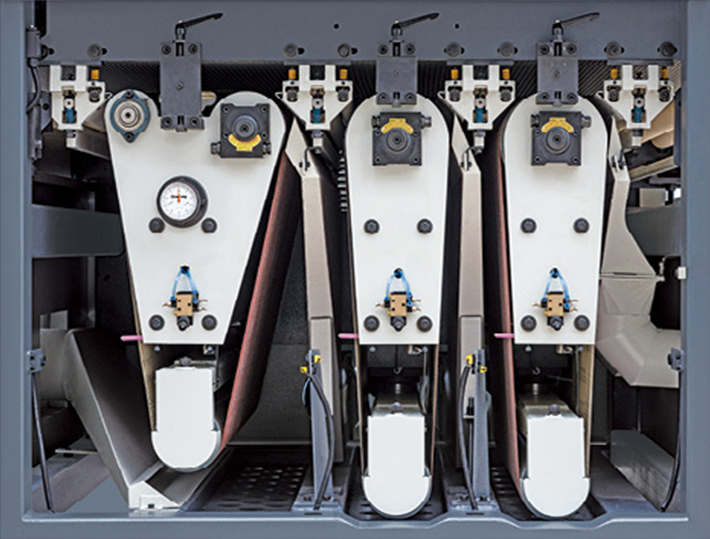
4. The rollers are tested by a dynamic balancing tester, and the correction accuracy can be controlled within the range of 1g-3g, which is 20% higher than the national standard, improving the sanding accuracy and avoiding the generation of ripples.
5. The pressure roller device adopts a unique coarse and fine three-roller transmission structure, which effectively controls the flatness and dimensional accuracy of the plate during sanding.
6. The surface of the conveyor bed is mirror-finished with high flatness. After high-temperature aging, the material is stable and will not deform, and the precision stability is extremely strong.
7. The bottom sander has a unique conveying design with a vacuum adsorption device, which makes the plate transportation smoother, more stable and firm.

